
Transcranial Magnetic Stimulation Course

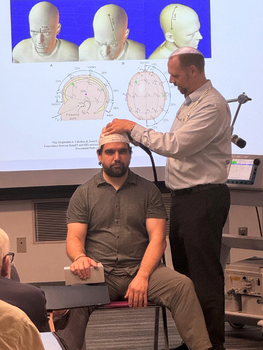
Greg Sahlem, PhD & Bobby Charalambous, PhD, demonstrate TMS in one of the 2026 courses.
TMS course instructors Gregory Sahlem, PhD, and Bobby Charalambous, PhD, demonstrate TMS in one of the 2026 courses.

The three-day course offers intensive training on Transcranial Magnetic Stimulation (TMS). TMS is an FDA-cleared treatment for depression, obsessive-compulsive disorder, migraines, smoking cessation and cortical mapping.

Sponsored by the Duke University School of Medicine, the Duke TMS Course includes didactic sessions and hands-on administration of TMS. The didactic sessions with the TMS faculty of Duke University cover all topics relevant to running a TMS clinical service and a TMS research lab, including:

  • Device principles and types
  • Neuroscience of TMS
  • Motor threshold determination
  • Treatment technique
  • Stimulus dosing
  • Risks, complications and contraindications
  • Safety screening
  • Post-TMS management and continuation treatment
  • Clinical and non-clinical research applications
  • Emerging brain stimulation techniques

“This is one of the best trainings I have attended in the past five years. It was worth every penny and the effort to get here. I cannot think of any way it could be improved.”
— September 2026 course participant

This activity is designed for credentialed clinicians (physicians, nurses, nurse practitioners, and physician assistants) and researchers who wish to enhance their knowledge of TMS and related brain stimulation techniques. The course session is capped at 30 participants.

At the conclusion of this course, participants should be able to:
  • State the rationale for the use of TMS in depression, obsessive compulsive disorder and off-label conditions
  • Explain regulatory issues and policies concerning TMS
  • Name the two main components of transcranial magnetic stimulation devices
  • Operate the TMS device and correctly use it to determine the optimal site and motor threshold
  • Describe the findings from TMS research in imaging and motor cortex excitability studies
  • Apply the indications for use of TMS in depression
  • Identify the risks and side effects of TMS and describe how to conduct a safety screening
  • Design a protocol for seizure management during TMS administration
  • Outline steps necessary to set up a TMS service/lab

Schedule

The fellowship, currently offered on a quarterly basis, is held on a Saturday from 8:30am to 6pm, Sunday from 8:30 am to 7:30pm and Monday from 8:30am to 3:30pm. Attendees must attend all three days of the course in order to receive full continuing education credit for the course. Upcoming dates in 2027 are as follows:

  • March 6-8, 2027
  • April 24-26, 20227
  • July 24-26, 2027
  • October 23-25, 2027

Cost

The course cost is $3,695 for all participants. Discounts are not available. There are no holds, and registration is first come, first served. 

Location

The course will be conducted at Duke University School of Medicine in the Duke Clinic Building, 40 Duke Medicine Circle (302 Trent Drive), Durham, NC 27710.

Registration

Before registering, please see the Covid-19 policy and cancellation policy below. Only register with an email address that will stay current! If registering for others, use THEIR information and NOT yours.

The Duke TMS Course only accepts credit card payments.

Register for the Course
 

COVID-19 Policy

The new Covid-19 vaccination is appreciated, but not required to attend this course.

The 2026 courses are planned to be held in-person unless otherwise indicated. If the need to transition to a virtual Zoom format arises due to circumstances out of our control, we will let you know via email. Masks are only required in some clinical areas. 

Cancellation Policy

Full credit card payment is due at the time of registration. A written notice of cancellation must be received 30 days prior to the start of this activity. A 30% ($1,108.50) cancellation fee will be assessed at that time; after that date, cancellation requests cannot be honored and no refund will be issued. In the event that the program is canceled or postponed, we will not be responsible for any travel costs or expenses, including cancellation/change penalties assessed by airlines, travel agencies or hotels. Please contact marisa.spurrell@duke.edu with questions.

Participants must attend all three days of the course, and sign in for all three days, in order to receive full credit for the course. 

After the course is over, in order to generate a CME certificate, participants are required to create a Duke OneLink Account and answer a few short questions about their credentials (which the CME office calls an evaluation, but is separate from the in-course evaluation which you will fill out at the end of the course), attest to your CME credit hours (maximum 20), and download your CME certificate. 

Please create your Duke OneLink account before the course starts. Participants will be emailed with detailed instructions for how to do this, after the course is over as well, once the CME office reviews your attendance. Once you print out your own certificate and make a pdf copy of it, you must keep it in a safe place in your office and as a digital file because Duke does not retain this information, in case you need it in the future. It will now be your responsibility. If you are a Duke employee, you must log in to your Duke OneLink account. Please email CEPD-JAC@dm.duke.edu  with any questions regarding signing up after the course is over.

CME Disclaimer

After completion of the Duke Transcranial Magnetic Stimulation course, you will receive continuing medical education (CME) credit of up to a maximum of 20.0 AMA PRA Category 1 Credit(s) once you create your Duke OneLink account to download your certificate. The CME credit is for an educational experience that does not involve treatment of patients. Therefore, it does not and cannot attest to a provider’s clinical competency. Clinical competency is the responsibility of the hiring institution or business to assess and must adhere to state regulations. The CME certificate that you will download only verifies your attendance and CME credit hours of learning. The course does not attest to your clinical competency which would be done by your institution or the medical director at your clinic.

Process for Obtaining CME

Someone from the CME Office will reach out directly with instructions on how to claim your credit after the course is over. Learners do not need to contact the CME coordinator before receiving this email. After completion of the Duke Transcranial Magnetic Stimulation course, in order to download your (CME) credit of up to a maximum of 20.0 AMA PRA Category 1 Credit(s), you must use your Duke OneLink account to download your certificate.

  • Physician credit: Duke University Health System Department of Clinical Education and Professional Development designates this activity for a maximum of ____ AMA PRA Category 1 Credit(s)™. Physicians should claim only credit commensurate with the extent of their participation in the activity.
  • Nurse credit: Duke University Health System Department of Clinical Education and Professional Development designates this activity for up to ____ credit hours for nurses. Nurses should claim only credit commensurate with the extent of their participation in this activity.

Important: All requirements must be maintained throughout the activity to prevent credit revocation.

Maximum credit 20.0 AMA PRA Category 1 Credit(s). 

Please note: 

  • Once credit-claiming instructions are emailed to participants, learners will have 60 days from the date of the email to claim their credit.
  • Learners must have an active Duke CE profile to document attendance and receive CE credit.
  • Duke learners with an account must create a CE (Ethos) profile.
  • Non-Duke learners must register and activate a Duke OneLink account.

Please email the Continuing Education (CE) office at CEPD-JAC@duke.edu with any questions.

All faculty members are from Duke University unless otherwise noted.

Noreen Bukhari-Parlakturk, MD, PhD, MHSc
Assistant Professor of Neurology
Division of Movement Disorders
Faculty Network Member of the Duke Institute for Brain Sciences

Bobby Charalambous, PhD
Medical Instructor in the Department of Neurology

Asa Cordle, MD
TMS Clinic Director, Partner, Raleigh Psychiatric Associates

Wayne Feng, MD
Professor in the Department of Neurology

Jacob Feigal, MD
Assistant Professor of Psychiatry and Behavioral Sciences
Assistant Professor of Medicine
Medical Director, Duke Transcranial Magnetic Stimulation Clinic

Leah D. Fryml, MD
Staff Psychiatrist, Durham VA Medical Center

Tommy G. Fu, MD
Assistant Professor of Psychiatry and Behavioral Sciences
Psychiatrist, Duke Electroconvulsive Therapy Clinic, Duke Regional Hospital

Nimesha Gerlus
Student, Department of Psychology & Neuroscience

Stefan Goetz, PhD
Assistant Professor in Psychiatry and Behavioral Sciences
Assistant Professor in Electrical and Computer Engineering
Assistant Professor in Neurosurgery
Faculty Network Member of the Duke Institute for Brain Sciences

Grace Gunderson Falcone, RN, DNP, PMHNP-BC, FNP, A/GNP-C, BC
Doctor of Nursing Practice (DNP), ECT Program Director
Clinical Associate Professor, Duke University School of Nursing

Tonisha Kearney-Ramos, PhD
Associate Professor
Department of Psychiatry & Behavioral Sciences

Andrada D. Neacsiu, PhD
Assistant Professor
Department of Psychiatry & Behavioral Sciences

Angel V. Peterchev, PhD
Associate Professor
Department of Psychiatry & Behavioral Sciences
Departments of Biomedical Engineering, Electrical & Computer Engineering and Neurosurgery (secondary)

Scott R Polick, DO
Medical Assistant Professor 
Department of Psychiatry & Behavioral Sciences

Collin Price, MD
Assistant Professor
Department of Psychiatry & Behavioral Sciences

Greg, Sahlem, MD
Associate Professor 
Department of Psychiatry and Behavioral Sciences

Jonathan R. Young, MD
Staff Psychiatrist, Durham VA Medical Center
Medical Assistant Professor, Department of Psychiatry & Behavioral Sciences

The information provided at this CME activity is for continuing medical education purposes only and is not meant to substitute for the independent medical judgment of a clinician relative to diagnostic and treatment options of a specific patient’s medical condition. Completion of this course does not imply clinical competence to administer TMS or any other form of clinical management.

Statements by industry representatives during the industry device demos and exhibits may not reflect the views and opinions of the course organizers and faculty.

The following speakers and/or planning committee members have indicated they have no relationship(s) with industry to disclose relative to the content of this CME activity:

  • Noreen Bukhari-Parlakturk, MD, PhD, MHSc
  • Charalambos Costas Charalambous, PhD
  • Asa Cordle,MD
  • Tommy Fu, MD
  • Leah Fryml, MD
  • Nimesha Gerlus, MD, PhD
  • Grace Gunderson Falcone, RN, DNP, PMHNP-BC, FNP, A/GNP-C, BC
  • Tonisha Kearney-Ramos, PhD
  • Skye Napolitano, PhD
  • Andrada Neacsiu, PhD
  • Scott Polick, DO
  • Marisa Spurrell, BA

The following speaker/planning committee members have indicated that they have relationship(s) with industry to disclose:

  • Angel V. Peterchev, PhD, inventor on patents and patent applications on TMS
    • Rogue Research – Royalties for cTMS/ElevateTMS patents, consultant
    • MagVenture – TMS device loan
    • Magstim – Hardware donation
    • Ampa Health – Consultant, equity options, scientific advisory board
    • Magnetic Tides – Consultant, equity options, travel support
    • Motif Neurotech – Research funding
       
  • Wayne Feng, MD, FAHA
    • National Institute of Health 
      • Optimizing Transcranial Direct Current Stimulation Current and Electrode Montage for Stroke Patients (P20 GM109040, Feng-contact PI).
        TRANScranial direct current stimulation for POst-stroke motor Recovery – a phase II sTudy (TRANSPROT2, U01NS102353, U01NS102353-04S1, Feng-contact-PI)
      • Duke-UNC Eastern North Carolina and Southern Virginia RegIonal Stroke trIal cONsortium (ENVISION, U24NS135250, Feng-contact PI)
      • Transcranial Electrical Stimulation in Stroke EaRly After Onset Clinical Trial-2 (TESSERACT 2, 1UG3NS134619, Feng-MPI, starting on 07/01/24)
      • Combining rTMS & Aerobic exercise to treat depression and improve post-stroke walking (RESTORATION, 1R01HD113299-01A1, Feng-MPI)
    • American Heart Association/American Stroke Association
      • Prediction and Imaging Biomarker for Post-Stroke Motor Recovery (14SDG18290003, Feng-PI)
      • Optimizing parameters of Low Intensity Focused Ultrasound for Cortical Modulation in stroke patients (20IPA35360039) (PHA1287339, Feng-PI)
    • Burke Rehabilitation Institute (advisory member)
       
  • Jonathan R. Young, MD, ownership interest with: 
    • Physicians United
    • General Electric Co.
    • Reinsurance Group of American, Inc.
    • Navidea Biopharmaceuticals, Inc.
       
  • Gregory L. Sahlem, MD
    The following grants supported the research described in this presentation: K23DA043628, K12DA031794, R25DA020537, K24DA038240, R21DA036752
    • Received the use of an rTMS device from Magventure, for use in an investigator initiated trial, and has collaborated with MECTA as part of an investigator initiated trial. He additionally consults for and has equity in the company Trial Catalyst and consults (unpaid) for the company vitalize USA.
    • We will discuss both on and off-label applications of rTMS for substance use disorders.
       
  • Stefan Goetz, PhD
    • Assisted with Ampa device design
    • Received research funding from Magstim
    • Received research funding from Rogue Research
       
  • Jacob Feigal, MD
    • Sigmastim Medical Advisory Board
       
  • Collin Price, MD
    • Compensation: AbbVie, Inc., spouse/domestic partner receives compensation
    • Former compensation: Cal-Neuro Research Group

Duke University Health System Department of Clinical Education and Professional Development designates this live activity for a maximum of 20.0 AMA PRA Category 1 Credit(s). Physicians should claim only credit commensurate with the extent of their participation in the activity. 

In support of improving patient care, Duke University Health System Clinical Education and Professional Development is accredited by the American Nurses Credentialing Center (ANCC), the Accreditation Council for Pharmacy Education (ACPE), and the Accreditation Council for Continuing Medical Education (ACCME), to provide continuing education for the health care team. The designation was based upon the quality of the educational activity and its compliance with the standards and policies of the Accreditation Council for Continuing Medical Education (ACCME), the Accreditation Council for Pharmacy Education (ACPE), and the American Nurses Credentialing Center (ANCC).

  • Physician credit: Duke University Health System Department of Clinical Education and Professional Development designates this activity for a maximum of ____ AMA PRA Category 1 Credit(s)™. Physicians should claim only credit commensurate with the extent of their participation in the activity.
  • Nurse credit: Duke University Health System Department of Clinical Education and Professional Development designates this activity for up to ____ credit hours for nurses. Nurses should claim only credit commensurate with the extent of their participation in this activity.

Important: All requirements must be maintained throughout the activity to prevent credit revocation.

If you have any questions, please contact the Continuing Education (CE) Office at CEPD-JAC@dm.duke.edu.
Joint Accreditation Interprofessional Continuing Education logo

To learn more, contact Marisa Spurrell at marisa.spurrell@duke.edu.