

Depth and breadth of experiences across diverse clinical settings has long been a hallmark of the Duke University health service psychology doctoral internship program, housed in the Department of Psychiatry & Behavioral Sciences. And beginning in Summer 2026, the program grew deeper and broader, when it merged with Duke’s Counseling and Psychological Services (CAPS) internship.
While both programs have been providing top-notch American Psychological Association-accredited training for decades, they’ve been operating on parallel tracks until recently, when health service psychology doctoral internship director Chris Mauro, PhD, had an aha moment.
Mauro realized that combining the two internships would enhance both programs, enrich the intern experience, and increase Duke students’ access to behavioral health services. And as one of the only programs of its kind in the country, it would also further differentiate Duke from other psychology doctoral internship programs, which are yearlong clinical training placements required to complete a PhD in clinical, counseling, or school psychology.
Joining forces would also help revive the CAPS internship, which had been inactive since July 2025. Prior to that, CAPS offered a robust internship with a strong reputation that drew several interns each year.
A partnership evolves
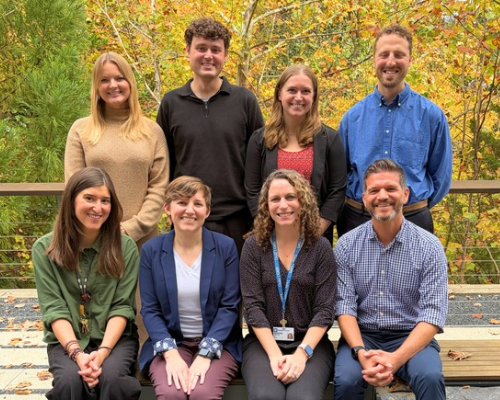
Combining the programs allowed Mauro to add a student mental health concentration to the internship’s other 10 concentrations, which include specialties such as autism, cancer support, eating disorders, trauma, and women’s health. Four of the program’s 11 interns now train at CAPS. Student mental health intern Michael Diana spends four days a week at the counseling center, and three interns from other concentrations work at CAPS two days a week. Diana spends his fifth weekday at the Duke Center for Adolescent and Young Adult Substance Use Treatment.
“It's a win for our interns to be able to provide services at a counseling center and learn how counseling centers work. And it’s a win for CAPS because they get to work with four interns with a range of expertise and experiences that are relevant to the Duke student population that CAPS serves.”
— Chris Mauro, PhD
“The learning goes both ways. CAPS interns bring fresh perspectives and knowledge of emerging practices, offering opportunities to rethink care coordination and strengthen the center’s processes,” said CAPS director Nadia Damani-Khoja, PhD, MBA. “Their questions and insights can help the team examine familiar approaches with fresh eyes, fostering a culture of continuous learning that benefits trainees, supervisors, and the students they serve.”
The merger builds on a growing partnership, with a sizeable team of psychiatrists, psychiatry trainees, and psychologists from the Department of Psychiatry & Behavioral Sciences on the CAPS staff.
“All the supervisors are amazing specialists in areas like ADHD, eating disorders, or cognitive behavioral therapy. They have so much to offer CAPS and the trainees — I feel it’s a match made in Heaven for us,” noted Damani-Khoja, who joined the center in July 2025.
That specialized expertise has enabled Damani-Khoja to expand CAPS’ offerings to better serve students. For example, John Mitchell, PhD, an associate professor in psychiatry and behavioral sciences, has provided ADHD-focused individual therapy, ADHD groups, and drop-in groups for students to learn more about the disorder and evidence-based treatment options. Students also have access to medication management for ADHD through CAPS psychiatrists.
And when students need services beyond what the counseling center can provide, the CAPS-Psychiatry & Behavioral Sciences partnership helps streamline the referral process to a Duke behavioral health clinic.
Broadening perspectives
Diana, a counseling psychology PhD student at the University of Kansas, was drawn to the Duke internship’s integration of training in student affairs and the medical model. It was the only program he applied to that does not focus strictly on college counseling.
“Experiencing both settings really helps broaden my perspective and gives me a more nuanced understanding of what it’s like to work in different places. It makes me think about how I can show up as a professional within a college counseling center and at an outpatient clinic, which has been very helpful.”
— Michael Diana
Long term, Diana wants to work in academia at an undergraduate-focused university, splitting his time between teaching, research, and clinical practice. “I wanted to do the student mental health concentration because the more time I get to spend with college students, the more I feel like I’m preparing myself for my future career,” he said.
A sound financial decision
In addition to benefitting interns and students, merging the two programs made financial sense. Combining budgets allowed Damani-Khoja to maintain the equivalent of two full-time CAPS interns while reducing some of the administrative demands of the internship, such as the need for a full-time training director. Instead, Leigh Spivey-Rita, PhD, an assistant professor of psychiatry and behavioral sciences, was appointed the CAPS site training director. Spivey-Rita, a therapist and clinical supervisor at CAPS, also holds several other roles in Psychiatry & Behavioral Sciences.
Importantly, the merger also allowed Mauro to increase intern stipends by about 25 percent from previous years.
Libby Skiles, EdD, assistant vice president of student well-being at Duke, fully supported the effort to merge the internship programs. “By bringing these teams together with their respective expertise, we have created a model that not only strengthens support for students and expands training opportunities but also reinforces Duke’s collaborative approach to health and well-being,” she said. “It’s an incredible benefit to our teams and our trainees, but most importantly, to our students who are the beneficiaries of this collaboration.”
So far, so good
A few months into the reimagined internship, Mauro and Damani-Khoja remain confident and enthusiastic about the new program.
“What I'm most excited about is the potential for continued collaboration and benefits for the counseling center, the internship program, and the interns—not to mention the university and the health system,” said Mauro. “Duke can be a leader in demonstrating how university counseling centers and academic medical centers can partner effectively to offer an innovative internship program for psychologists in training.”
For Damani-Khoja, CAPS is not only a place where future psychologists develop their skills — it’s also a center strengthened by its role in their training. “This really feels like ‘One Duke’ in action. The synergy is very exciting,” she reflected.
And Diana couldn’t be happier with matching at Duke. “I absolutely love it. I get to work with such a wonderful team,” he shared. “One of the things I’ve appreciated most is that my supervisors have allowed me to explore my clinical identity and try new things while supporting me along the way.”