

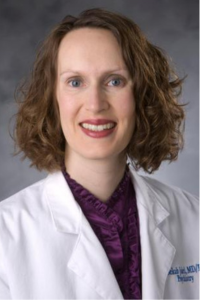
“There’s a real opportunity—and need—to set a positive tone about psychiatry and dispel stigma about behavioral health conditions early in medical school,” said Rebekah Jakel, MD, PhD, an associate professor of psychiatry and behavioral sciences at the Duke University School of Medicine.
Jakel aimed to do just that when she transformed the psychiatry curriculum earlier this year from a traditional lecture-based format to an interactive case study approach. It’s been a refreshing change for first-year medical students and the faculty who teach them.
Psychiatry Curriculum Comes into its Own
Medical students at Duke complete all their pre-clinical coursework in the first year of medical school, with the first semester dedicated to the body in health, and the second semester focused on medical conditions, illnesses, and diseases.
Prior to 2020, the one-week psychiatry curriculum was embedded as part of a “Brain and Behavior” course at the end of the first semester. “Dr. Shelley Holmer [vice chair of adult psychiatry and psychology clinical services] and I attempted to discuss psychiatry in terms of brain function, which is incredibly complex,” Jakel recalled. “Trying to explain human behavior is complicated and beyond the scope of a week.”
In the spring of 2020, recognizing the importance of incorporating behavioral health education early in medical school, first-year course directors Andrew Muzyk, PharmD, MHPE, and Matt Velkey, PhD, moved the psychiatry component to the second semester and expanded it to two weeks.
Several psychiatry and behavioral sciences faculty members presented the curriculum through a series of lectures and panels, delivered virtually due to the Covid pandemic. The extra time enabled faculty to discuss a broader range of topics, including an introduction to the Diagnostic and Statistical Manual of Mental Disorders (DSM) and a number of psychiatric diagnoses and treatments.
“I think it makes sense for the psychiatry component to be included in the second semester curriculum, with behavioral health conditions being addressed in ways similar to other illnesses like diabetes and stroke,” said Jakel. “Mental health is a fundamental part of healthcare, and this placement can help reinforce that.”
“I think it makes sense for the psychiatry component to be included in the second semester curriculum, with behavioral health conditions being addressed in ways similar to other illnesses like diabetes and stroke. Mental health is a fundamental part of healthcare, and this placement can help reinforce that.”
— Rebekah Jakel, MD, PhD
Challenges Prompt New Approach
The extra week allotted for psychiatry and the placement within the second semester allowed for a significant revamp of the preclinical psychiatry curriculum. But when virtual instruction transitioned back to in-person sessions after the pandemic crisis subsided, a new challenge emerged.
Students had gotten accustomed to online learning, and as in many learning environments, it was increasingly difficult to engage them in a traditional onsite lecture format. In-person attendance was not mandatory, and the lectures were recorded, so students could watch them at their convenience. But Jakel worried about asking busy faculty members to take time out of their clinics to give lectures with only a small number of students in the room.
This concern prompted a new iteration of the curriculum in the spring of 2025, which leveraged the existing recorded lectures and added an interactive component that drew students back to campus and engaged them in navigating hypothetical clinical scenarios.
Jakel developed multiple case studies in five topic areas: child psychiatry, psychosis, mood and anxiety, eating disorders, and trauma and personality. Psychiatry resident Noorin Damji, MD, also contributed a case. After watching the recorded lectures, students came to campus for topic-based, small group case discussions facilitated by faculty members, senior residents, and fellows. The five mandatory sessions, most of them two hours long, were scheduled at times when the students were already on campus.
“It was a wonderful opportunity bring the material to life through vignettes of different conditions and discuss how a student might approach diagnosis or treatment,” said Tara Chandrasekhar, MD, director of the child and adolescent psychiatry fellowship, who facilitated one of the discussions. “The students were very engaged, asked fantastic questions, and showed great insight. I’m looking forward to doing it again this year!”
“They were so engaged with the cases and excited to learn about psychiatry, and we had a great discussion. It re-energized me about teaching.”
— Nicole Helmke, MD
Nicole Helmke, MD, director of the medicine-psychiatry residency program, had a similar experience. “They were so engaged with the cases and excited to learn about psychiatry, and we had a great discussion. It re-energized me about teaching,” she reflected.
And some students have expressed that the curriculum has prepared them well for the psychiatry clinical rotation in their second year, making them more comfortable interacting with patients.
Drawing Students into Psychiatry
Jakel is grateful for the opportunity to work with Muzyk and Velkey to reshape the psychiatry curriculum and help students learn about behavioral health conditions regardless of whether they plan to pursue psychiatry. This exposure is important, she notes, because physicians across all specialties are likely to encounter patients with these conditions.
And she hopes some students may be unexpectedly attracted to this specialty through their experiences engaging with the psychiatry curriculum and clinical rotation. “Medical students are often seeking to develop strong relationships with patients, and psychiatry is a really great field for that,” she noted.
Julie Penzner, MD, vice chair for education and director of undergraduate medical education in the Department of Psychiatry & Behavioral Sciences, also sees potential in the updated curriculum to spark interest in the field among medical students.
“With the critical need for more psychiatrists in the workforce, it’s particularly important to provide as many positive early experiences with psychiatry as possible,” said Penzner. “And Dr. Jakel’s new approach to the curriculum is such a great example of this.”
“With the critical need for more psychiatrists in the workforce, it’s particularly important to provide as many positive early experiences with psychiatry as possible. And Dr. Jakel’s new approach to the curriculum is such a great example of this.”
— Julie Penzner, MD